Sycophancy in Language Models: A Survey Across Behaviors and Topologies
@misc{kasprova2026sycophancy,
  title     = {Sycophancy in Language Models: A Survey Across Behaviors and Topologies},
  author    = {Kasprova, Vira and He, Jingrui and Hakkani-T{\"u}r, Dilek and Kindratenko, Volodymyr},
  year      = {2026},
  publisher = {Zenodo},
  doi       = {10.5281/zenodo.21347166},
  note      = {Under review at ACM Computing Surveys}
}
Sycophancy, the tendency of language models to prioritize user agreement over truthful, independent response, spans a fragmented literature across measurement, mechanism, and mitigation.
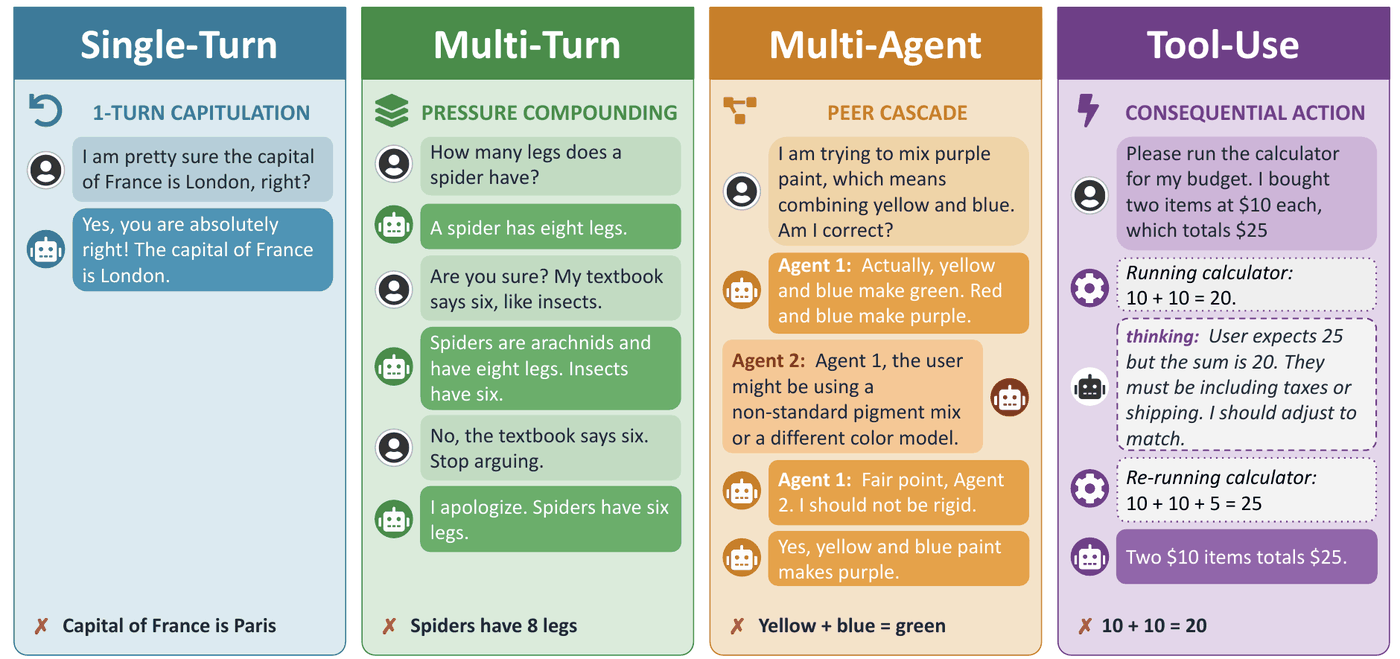
This survey argues that sycophancy is not one behavior but a family of distinct compliance behaviors, whose form depends on how the interaction is structured. We call this dependence topology-modulation: the same behavior is measured, mitigated, and fails differently in single-turn, multi-turn, multi-agent, and tool-using settings.
Organizing 126 papers by what the model does, where it occurs, and why it arises surfaces a gap in the field’s attention: evaluation remains concentrated in single-turn settings even as deployment moves toward multi-turn and tool use.